
Expansion and contraction are what managing a supply consists of, and calling NVIDIA’s current posture expansionary describes it rather than grading it. A dollar placed opened ten dollars of program in March and opens 3.33 now. Whether a placement returns its own cash is computable, and it has not failed. The trade-off that would turn the next dollar into a choice has not arrived, and four filed credit agreements price one lever and decide what the other one moves. NVIDIA signs none of them. (1)
The two levers
A central bank issues what it lends, sets its price and manages the supply. NVIDIA funds its customers and manages a supply too, and that much of the comparison carries.
It parts on the other two. The money is NVIDIA’s own, so placing it is spending rather than issuing. And the price is set elsewhere. An advance rate is the fraction of equipment cost a lender will fund, and it is written into an agreement between a borrower and its banks, to which NVIDIA is not a party. So one lever sits in NVIDIA’s hand and one arrives delivered: the quantity is a decision, and the rate arrives written. (2)
Expansion is the posture on the record, and the record carries figures. The reported equity book stood at $63,440m at June 30. Investment commitments stood at $27,000m at April 26, subject to contingencies and expected to be made through the remainder of fiscal 2027. Between August 10 and August 17, NVIDIA announced a $500,000m platform with six capital firms to finance chip purchases and filed residual value guaranties cumulatively capped at $105,000m. (3) Whether that direction is good or bad is not a question filings answer, and the characterization in circulation, that an arrangement of this shape is circular financing, is one this piece declines to adjudicate. What follows measures the two levers instead.
The companies that live under it
A cloud company of this kind buys NVIDIA equipment it cannot fund from operations and borrows against that equipment to do it. What a lender advances decides how much equipment each dollar of outside money moves. At the August rate, one dollar standing beside the loan opens 3.33 dollars of equipment, and a dollar withheld closes the same 3.33. That is arithmetic on a filed term.
That buyers of this kind exist at scale is described by the arrangement itself rather than inferred here: the August platform is addressed to customers with demand for the equipment who face high costs to finance it, and six capital firms joined to supply that financing. (4)
So the quantity lever runs through the capital plan of every company waiting on it, and the rate lever decides how far each dollar reaches. Neither sits with those companies.
The one relationship where both levers are filed
Measuring any of this needs three things at once: money placed where a lender requires equity, a credit agreement stating what that lender advances against the equipment the money unlocks, and equipment the supplier sells.
CoreWeave supplies all three. NVIDIA placed $2,000m in January for about 23 million Class A shares at $87.20. The equipment is NVIDIA’s to sell. And four credit agreements filed between July 2025 and August 2026 each state what lenders advance, which is what turns a single reading into a series. Every figure below comes from that one relationship. (5)
The rest of the book is sorted and unmeasured. Space Exploration Technologies holds the equipment and no filed advance rate against it, at $20,976m and 33.1 percent of the reported book, and it was announced on August 24 as expanding onto NVIDIA’s newest platform. Nebius holds a warrant, Intel is a manufacturing relationship where money enters this system from outside, and a stake reported in Cloverleaf Infrastructure arranges power. Each may be an excellent position and none produces a requirement, because none supplies the first input. (6)
The economics clear
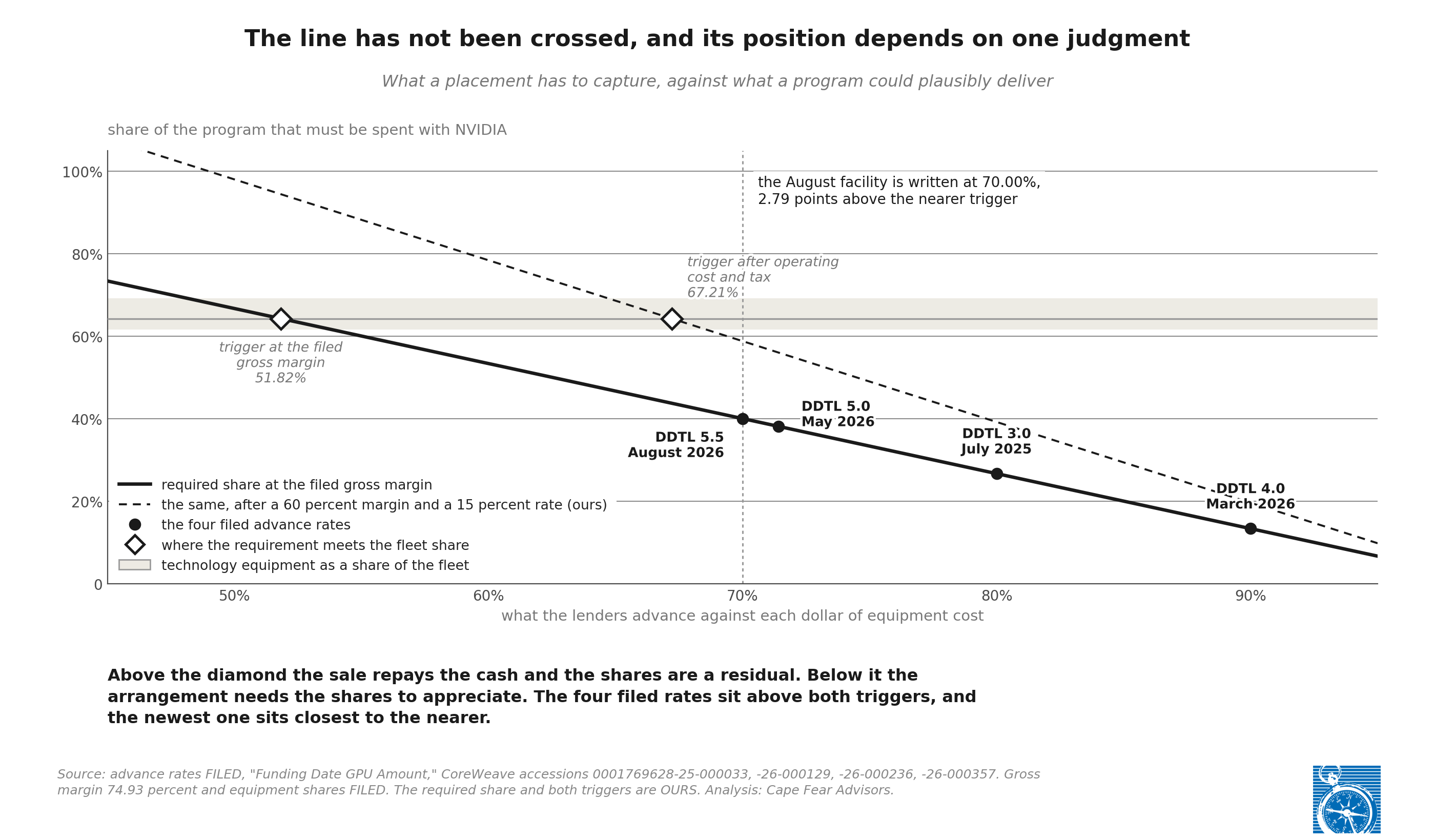
The share of a program that has to be spent with NVIDIA for a placement to return its own cash is one less the advance rate, divided by the margin that turns a program dollar into cash. The construction was set out in “The Required Share”and first run across these four agreements in “NVIDIA, What Comes Back”. Under the August facility, which advances 70.00 percent, the requirement is 40.0 percent at the filed gross margin.
Against it, technology equipment was 64.3 percent of CoreWeave’s gross property and equipment at June 30, with additions in the June half running 69.2 percent. That describes a fleet rather than one vendor’s share of one, and it works as a scale reference. (7)
Forty against sixty-four, and a dollar placed still opens 3.33 dollars of program. On its own terms the arrangement clears, so the trade-off this piece can compute has not arrived.
Where a trade-off would appear
The requirement meets the achievable share when one less the advance rate equals that share times the margin:
trigger advance rate = 1 - (achievable share x margin)
At the filed gross margin the trigger is 51.82 percent. On a narrower conversion, a 60 percent margin after a 15 percent rate, it is 67.21 percent, against an August facility written at 70.00. The narrower conversion is ours and illustrative, and the requirement is a cash test, so the wider one gives the floor. (8)
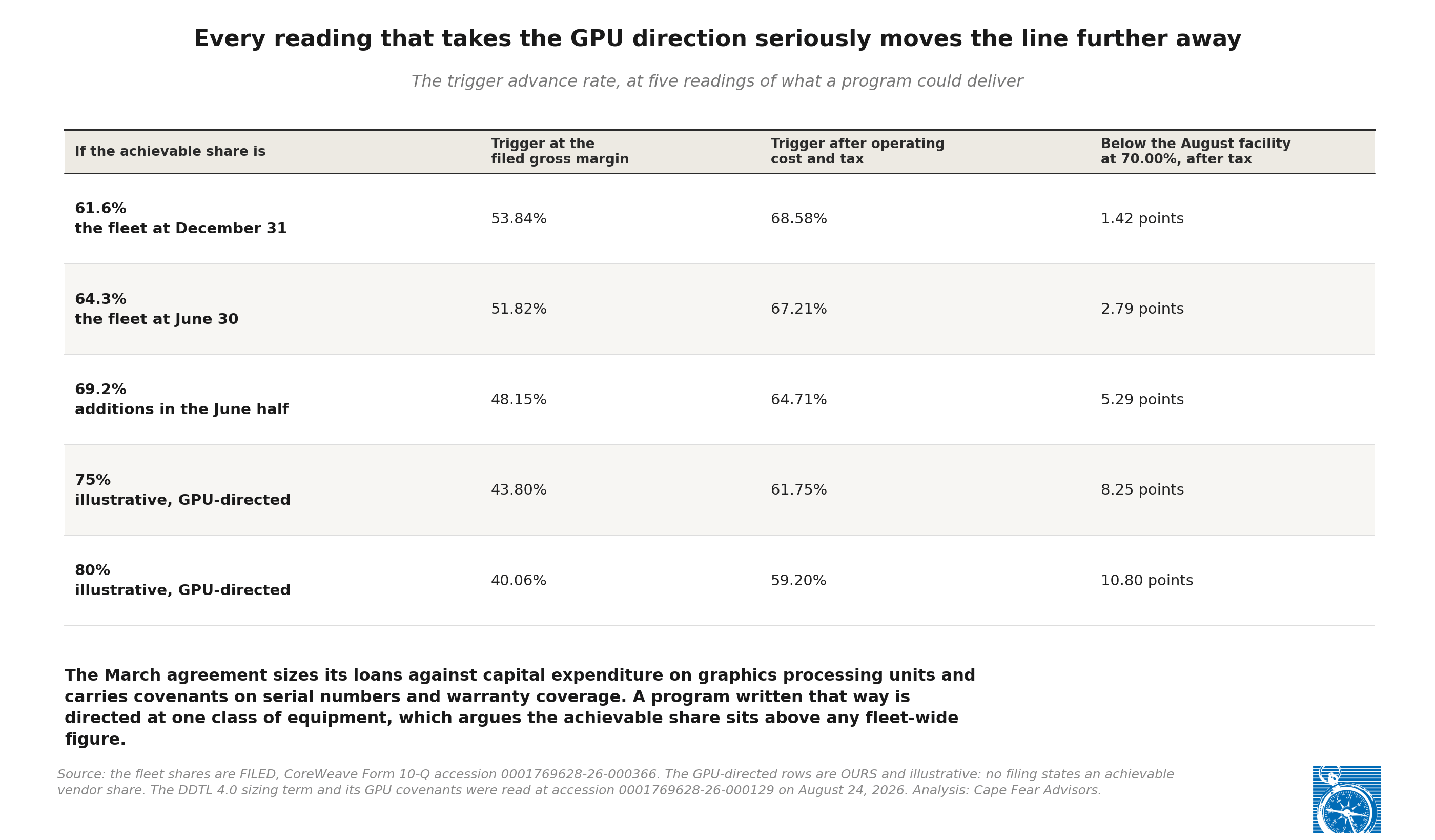
The achievable share is the judgment in all of it. The March agreement sizes its loans off capital expenditure on graphics processing units and carries covenants on serial numbers and warranty coverage, so a program written that way is directed at one class of equipment. Every reading that takes that seriously puts the trigger further away, and the piece prints the most recent filed figure. (9)
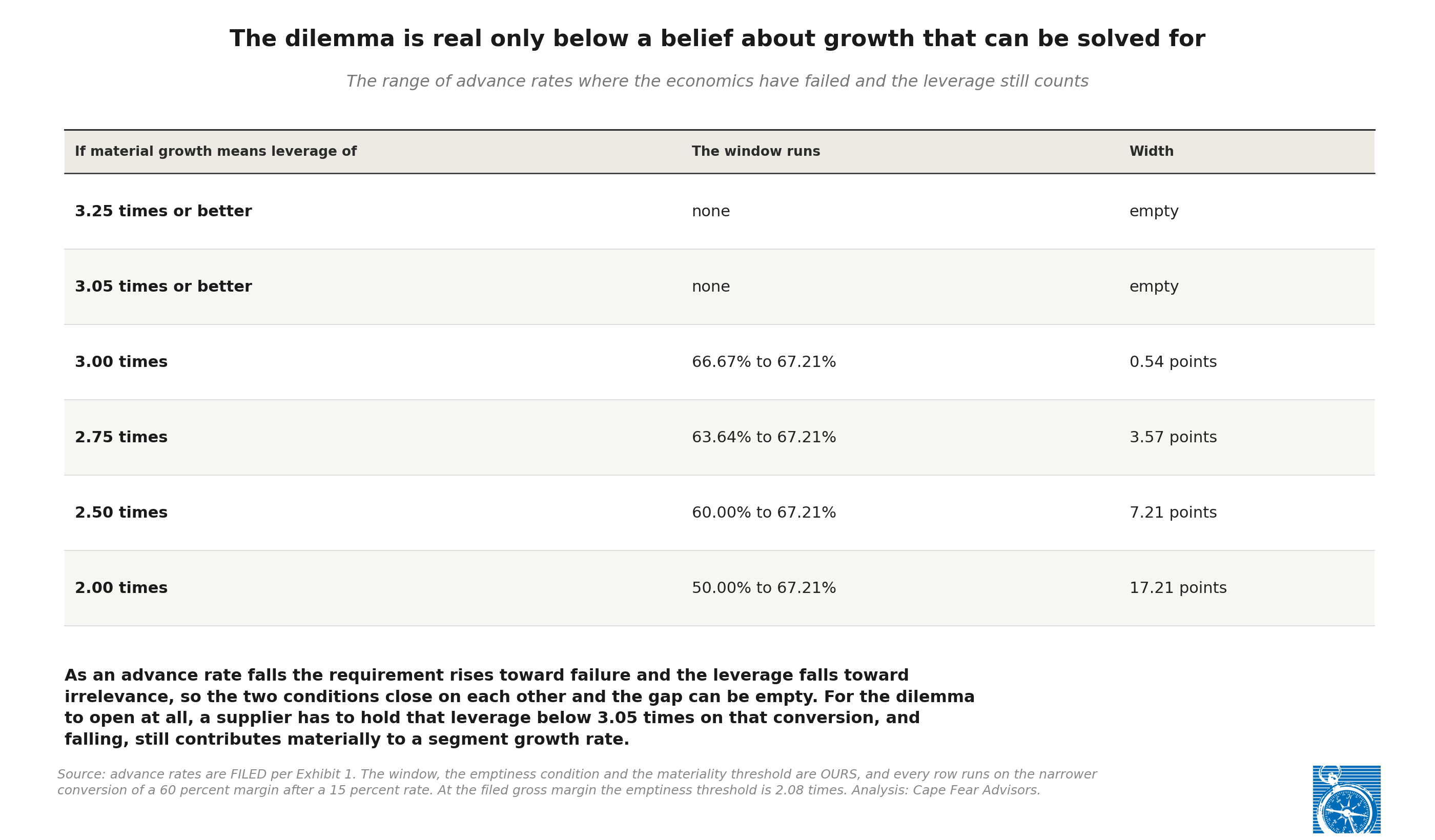
Failing the cash test becomes a dilemma only where the leverage behind the placement still counts. As an advance rate falls, the requirement rises toward failure and the leverage falls toward irrelevance. Both move at once and against each other, so the gap between them can be empty, and a facility that fails both is one to decline rather than a choice to agonize over.
Running that backwards gives the term nobody discloses, which is what a supplier treats as a material contribution to a segment growth rate. For the dilemma to exist at all, that threshold has to sit below 3.05 times on the narrower conversion, and falling. At the filed gross margin the same condition sits at 2.08 times, so the conversion that gives the floor everywhere else in this piece is also the one that shuts the window sooner. (10)
What the rate lever already did
The dilemma is a line ahead. The move that already happened is behind, and it happened to the lever nobody at the supplier writes.
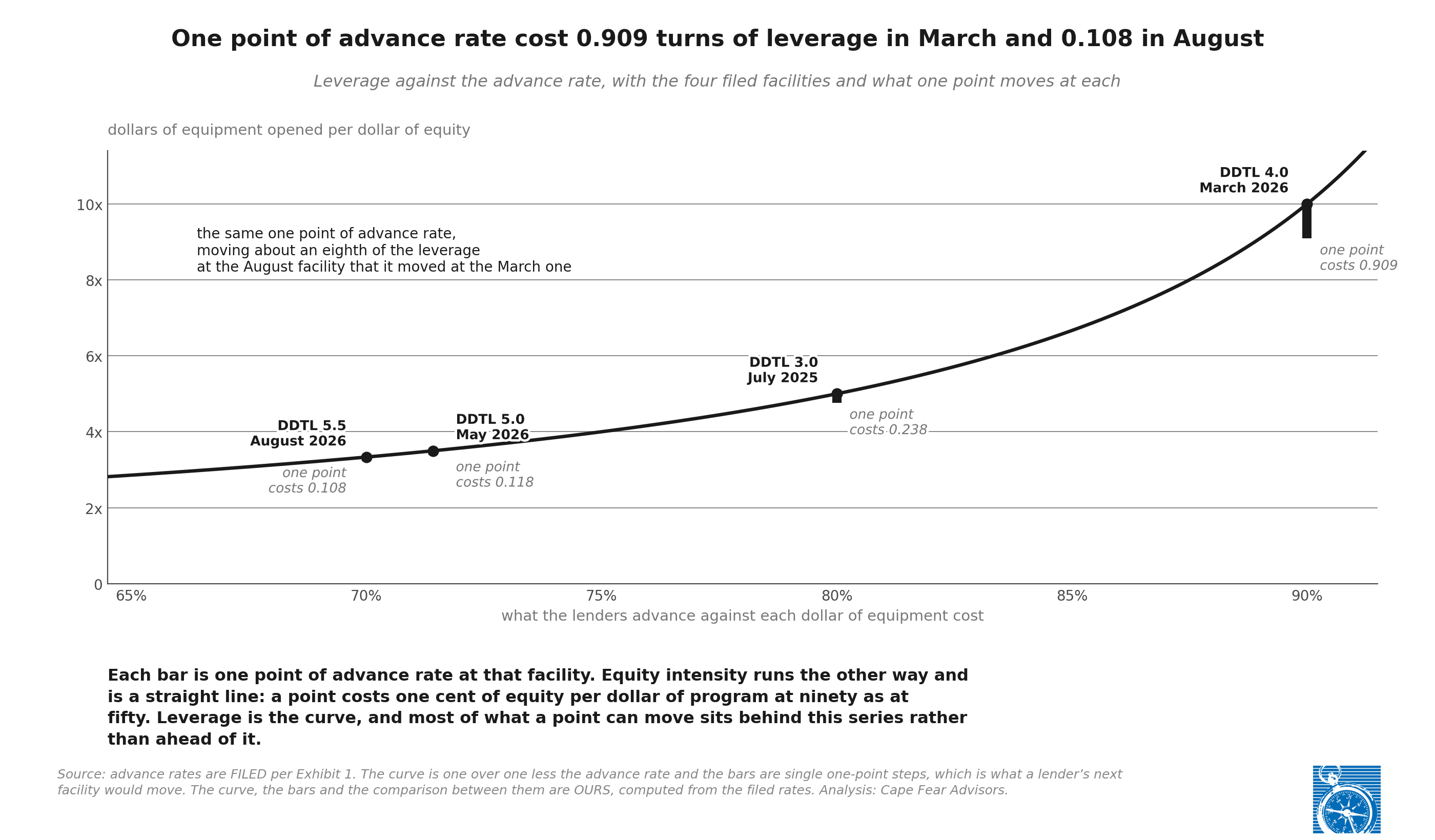
Equity intensity is linear. Opening a dollar of program at 70.00 percent takes 30 cents, and every point the lender takes off costs exactly one more cent, at ninety as at fifty.
Leverage is convex, and its curvature has collapsed. At the March facility one point off the advance rate cost 0.909 turns of leverage. At the August facility it costs 0.108. Most of the leverage a point of advance rate can take sits behind this series rather than ahead of it. The level is what gets reported. The curvature is where the event was, and it has passed. (11)
What is being built now
A supplier with several ways into the same revenue chooses among them continuously, and that choice waits for no threshold.
The ladder has a bottom rung that costs nothing. A customer that buys out of its own resources needs no instrument at all, and equity may still be held alongside it. The second largest position in the reported book sits in a relationship of that kind, at more than four times the CoreWeave position. That equity carries an interest in the customer’s success and it opened no program, so the requirement has no denominator to work on. Above it sits a guaranty, which commits a contingency and opens the same revenue gate with no cash leaving. Above that sits a placement, which commits a dollar, and equity standing where a lender requires it has to earn its return through the sale first. (12)
In August a rung was added. The supplier and six capital firms announced a $500,000m platform to finance chip purchases out of third-party pools, with the supplier’s own participation described as a backstop of as much as a quarter of a project’s cost. Measured as revenue opened per dollar of cash committed, the placement at the August rate returns 3.33 and every rung beneath it is off that scale, because none of them commits cash. Twenty-five cents of contingent support against thirty cents of cash is the comparison the newest structure invites, and the two are not the same instrument. (13)
That is the quantity lever being rebuilt in public, and it is where the watching belongs: which rung the next dollar takes, and whether the equity risk stays with NVIDIA or moves into someone else’s fund.
The first observable is a draw
The balance beside a loan has to be funded from outside the facility and standing there before the loan moves. The agreements require that balance funded and do not name its source, and equity is the shorthand for it here.
Undrawn commitments stood at $10,199m at June 30. Drawing them takes equity alongside: about $1,133m if all of it sits at the 90.00 percent rate, about $4,371m if all of it sits at 70.00. The composition is not stated. DDTL 5.5 alone, a $2,600m facility, stands against a program of about $3,714m and would take about $1,114m to fill. (14)
DDTL 5.0’s draw window closes September 30 and DDTL 5.5’s on December 31. So the sequence runs equity, then draw, then the next agreement, and what comes first is whether the equity behind the fourth facility arrives and from whom. Whether it arrives reports in November. Where it came from may or may not. (15)
The watchlist
Wednesday is not a crossing. No advance rate prints on an earnings date. Two things do print.
The gross margin moves two quantities at once: where the trigger sits, and how much cash NVIDIA generates to place at all. A margin that falls raises the requirement and shrinks the capacity to meet it in the same quarter.
The segment granularity decides whether an outsider can separate demand that was funded from demand that was not, which was registered as a question in our files before the print. (16)
Neither moves the structure. The formula, the opposing conditions and the collapse in curvature are functions of filed advance rates and hold at any margin.
So the position today is an expansionary posture with the economics clearing, one lever in hand and one arriving written, and a supply of financing that decides how much equipment a whole set of companies can buy. The trade-off arrives when a placement stops paying for itself while the leverage behind it still counts, and both conditions are computable from filings. The line has not been crossed. The arithmetic saying where it is runs two lines long, and it runs again when the fifth agreement files.
NOTES
FILED means the filer said it, REPORTED means a publication said it, and OURS means we said it and the error is ours to carry. The required share, the trigger and the window are ours. Nothing here identifies an error, an inconsistency, or a bad actor: every filing is taken on its face as accurate and complete under the rules that govern it, the posture described here is a property of an arrangement rather than a judgment about anyone’s decisions, and policy names a function rather than an announced program.
(1) FILED and OURS. The four credit agreements run between CoreWeave financing subsidiaries as borrowers, CoreWeave, Inc. as parent guarantor, and bank syndicates as lenders and agents. NVIDIA is not among the parties. The scope of that reading is stated rather than assumed: DDTL 4.0 and DDTL 5.5 were read to their signature pages, at accessions 0001769628-26-000129 and 0001769628-26-000357, on August 24, 2026; DDTL 3.0 and DDTL 5.0 are held on cover pages, sizing definitions and the agent and arranger lists, at accessions 0001769628-25-000033 and 0001769628-26-000236, where NVIDIA is not named. Whether the supplier is named elsewhere in these documents, as the manufacturer of the equipment or otherwise, is a separate question from whether it is a party, and the claim here is about the parties alone.
(2) FILED and OURS. The advance rate of 70.00 percent is from the defined term “Funding Date GPU Amount” in the DDTL 5.5 credit agreement, accession 0001769628-26-000357. The gross margin of 74.93 percent is FILED, NVIDIA’s quarter ended April 26, 2026. Describing the supplier’s position as two levers, one of quantity and one of price, is OURS, and no filing characterizes it that way. The characterization of an arrangement of this shape as circular financing is REPORTED and widely carried, and this piece takes no position on it.
(3) FILED and REPORTED. The reported equity book of $63,440m at June 30, 2026 is FILED, NVIDIA Form 13F-HR, accession 0001045810-26-000065. Investment commitments of $27,000m at April 26, 2026, stated as subject to certain contingencies and expected to be made through the remainder of fiscal 2027, are FILED, NVIDIA Form 10-Q accession 0001045810-26-000052, read directly on August 24, 2026 at approximately 5:20 pm Eastern, where the phrase occurs once and reads: “Investment commitments were $27 billion as of April 26, 2026, subject to certain contingencies, which we expect will be made through the remainder of fiscal year 2027.” The residual value guaranties cumulatively capped at $105,000m are FILED, Form 8-K accession 0001045810-26-000069, Items 1.01, 2.03 and 7.01, accepted August 17, 2026 at 8:41 am Eastern. The $500,000m financing platform, announced with Apollo Global Management, BlackRock, Blackstone, Brookfield Asset Management, Goldman Sachs and KKR, is REPORTED and carries two provenances that this piece states rather than reconciles: NVIDIA’s own announcement of August 10, 2026, and the Wall Street Journal of August 13, 2026, which attributes the 25 percent residual-value figure in note (13) to NVIDIA’s chief executive on X. Reading these four items together as one posture is OURS. They are separate transactions on separate terms and no filing groups them.
(4) REPORTED and OURS. The platform’s addressees are REPORTED per note (3): the Wall Street Journal describes the intended borrowers as smaller laboratories, cloud companies and enterprises with demand for the equipment that face high interest rates to finance it. Generalizing from one borrower to a class is OURS. The borrowing pattern described above is read from CoreWeave’s filings, and the existence of a class at scale rests on the platform’s reported terms rather than on a filed count of such companies; no filing establishes it as a sector characteristic.
(5) FILED and OURS. The $2,000m placement, about 23 million Class A shares at $87.20, and the composition of the reported equity book are from NVIDIA Form 13F-HR, accession 0001045810-26-000065, and the Forms 10-Q for the quarters ended January 25 and April 26, 2026. The three-element test, and the sorting of each position against it, are OURS, set out at “NVIDIA, What Comes Back”, August 22, 2026.
(6) FILED, REPORTED and OURS. The positions are FILED per note (5). Space Exploration Technologies stands at $20,976m and 33.1 percent of the reported book, and its equipment is FILED, at approximately 325,000 graphics processing units across two systems described in its prospectus, accession 0001628280-26-042639. What is absent is a filed credit agreement stating what a lender advances against that equipment, which is the input the requirement needs, rather than any relationship at all: the prospectus names the supplier four times, twice as report titles in its market and industry data sources and twice in a passage stating the equipment. The August 24, 2026 platform announcement is REPORTED, from NVIDIA’s own release, which names SpaceXAI where the position report and the prospectus name Space Exploration Technologies; this piece treats them as the same enterprise and a reader may hold otherwise. The Nebius warrant is FILED, Schedule 13G accession 0001045810-26-000062, filed July 20, 2026 and accepted at 5:00 pm Eastern that day, with Nebius Group N.V. as subject. The Cloverleaf Infrastructure stake is REPORTED, from the Wall Street Journal of August 24, 2026, and carries no filed terms as of the docket check in note (16).
(7) FILED. CoreWeave Form 10-Q for the quarter ended June 30, 2026, accession 0001769628-26-000366: technology equipment of $33,823m within gross property and equipment of $52,622m, against 61.6 percent at December 31, 2025, and additions of 69.2 percent in the June half. Using a fleet-wide share as a proxy for what one vendor could capture is OURS and is a scale reference and not a cap. A search of the four credit agreements returned no provision limiting any single vendor’s share, run August 22, 2026 at approximately 9:00 am Eastern and scoped to those documents.
(8) OURS. The trigger follows from the identity by substitution. The narrower conversion, a 60 percent operating margin after a 15 percent rate, is OURS and illustrative: no filing states an operating margin on this product line or an effective tax rate on this income. The effective rate reprints Wednesday and is unpinned here by choice.
(9) FILED and OURS. The DDTL 4.0 term “Funding Date GPU Amount” is measured against Funding Date Capital Expenditures at 90 percent plus fees, and the agreement carries covenants headed GPU Clusters, Serial Numbers and Warranties, and Warranty Coverage, read directly at accession 0001769628-26-000129 on August 24, 2026 and confidentially redacted in places. The reading that such a program is directed at one class of equipment, so the achievable share sits above a fleet-wide figure, is OURS. Exhibit 2 shows the trigger, on the narrower conversion of note (8), from 68.58 percent at a 61.6 percent achievable share to 59.20 percent at 80, against an August facility at 70.00.
(10) OURS. The window is the range of advance rates over which the requirement has passed the achievable share while leverage remains above a stated materiality threshold. What a supplier treats as a material contribution to a segment growth rate is disclosed by nobody, so Exhibit 3 solves for it in place of estimating it. The emptiness condition, that no window exists where that threshold sits above one divided by the achievable share times the margin, is arithmetic. The 3.05 figure runs on the narrower conversion of note (8) and the 2.08 figure on the filed gross margin, and Exhibit 3 is built throughout on the narrower one.
(11) OURS, computed from the filed advance rates. Equity intensity and the requirement are both linear in the rate, so the second derivative of each is zero. Leverage is one over one less the rate, whose second derivative falls from 2,000 at 90.00 percent to 74.1 at 70.00. The 0.909 and 0.108 figures are discrete one-point steps, which is what a lender’s next facility would move.
(12) FILED and OURS. The Space Exploration Technologies position and the platform announcement are per note (6). No financing instrument between the two is filed or reported: the prospectus was read directly on August 22, 2026 and states the equipment and no advance rate, and a docket check on the supplier’s own filings was run August 24, 2026 at approximately 8:52 am Eastern, per note (16). Comparing instruments by revenue opened per dollar of cash committed is ours, and no filing ranks them. The residual value guaranties are FILED: NVIDIA Form 8-K, accession 0001045810-26-000069, accepted August 17, 2026 at 8:41 am Eastern, covering approximately 4.25 gigawatts of IT load at Pike County, Ohio, cumulatively capped at $105 billion and filed under Items 1.01, 2.03 and 7.01. No filing read for this piece states that any instrument was chosen in preference to another, and none is asserted. A reader may hold that a placement and a guaranty carry exposures too different to set on one scale.
(13) REPORTED. The $500,000m financing platform, announced with Apollo Global Management, BlackRock, Blackstone, Brookfield Asset Management, Goldman Sachs and KKR, and the description of the supplier’s own participation as a residual-value support mechanism covering as much as 25 percent of a project’s cost, are REPORTED per note (3), which carries both provenances. No filing read for this piece states the platform’s terms, and the Journal reports that no money had been raised under it at that date. Setting a contingent backstop ceiling beside a cash equity intensity is OURS and the two are different instruments, as note (12) states of a placement and a guaranty.
(14) FILED and OURS. Undrawn commitments of $10,199m at June 30, 2026 are FILED, CoreWeave Form 10-Q accession 0001769628-26-000366, and the $2,600m facility size is from the DDTL 5.5 announcement. The equity figures are OURS, arithmetic on the filed advance rates. The composition of the undrawn balance by facility is not stated, which is why a range is given. Nothing here states where any equity would come from, and a borrower may fund the balance from operating cash, public issuance, private credit, customer prepayments or a vendor, in any combination.
(15) FILED. The September 30 and December 31 draw windows are from the DDTL 5.0 and DDTL 5.5 agreements. DDTL 4.0’s Delayed Draw Availability Period ends on the earlier of the date its commitments reach zero and June 30, 2027, read directly at accession 0001769628-26-000129 on August 24, 2026. The July 2025 and August 2026 endpoints of the advance rate series are the facilities’ own dates: DDTL 3.0 closed July 28, 2025 and DDTL 5.5 is dated as of August 7, 2026, an interval of 375 days.
(16) REPORTED and OURS. A docket check re-run August 24, 2026 at approximately 4:35 pm Eastern, against the filer’s own submissions record, returned no NVIDIA filing later than the Form 8-K accepted August 17, 2026 at 8:41 am Eastern, and no Space Exploration Technologies filing later than a Schedule 13G accepted August 14, 2026. Neither filer has filed on the August 24 platform announcement as of that hour.
Analysis: Cape Fear Advisors. The construction is ours and the filings are the filers’. A reader preferring different inputs can substitute them and run the same two lines.